The Napkin and How Trust Actually Erodes

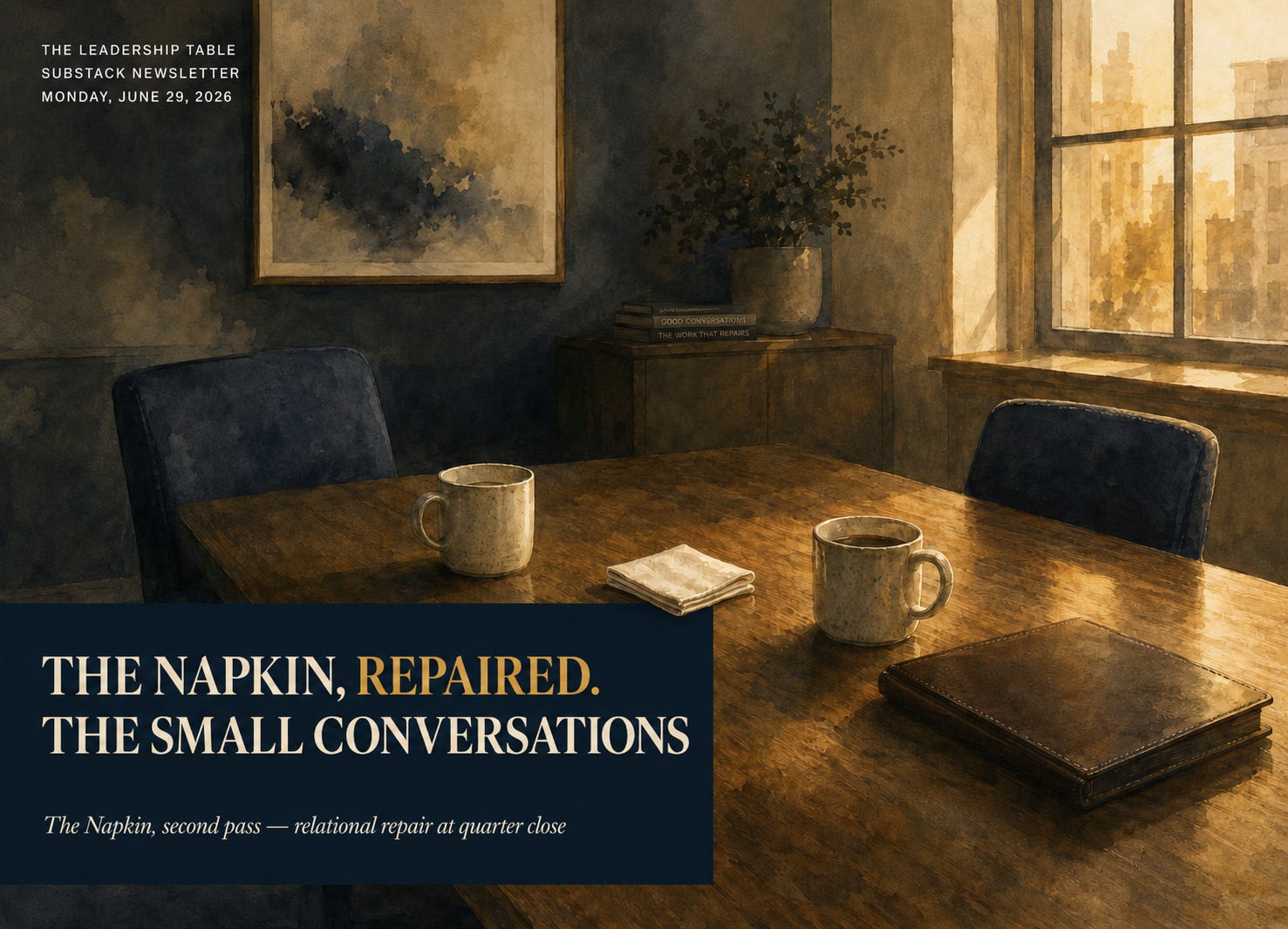
Trust is not lost in the dramatic moment.
It is lost in the pattern of small things.
The meeting where you checked your phone while someone was telling you something that mattered to them. The promise you forgot you made. The credit you did not give to the person who actually did the work. The interruption. The dismissive look. The conversation you were physically present for and emotionally absent from.
Each one is small. None of them seems consequential in the moment. Together, over months and years, they add up to a leader whose team has quietly stopped trusting them, and who often does not know it has happened.
This is the Q2 close. Thirteen weeks of the Place Setting Framework. Seven elements introduced, with several already on their second pass. Four months of the newsletter, the podcast, and Breaking Bread reaching deeper each cycle. We close the quarter the way we should: with The Napkin. The element most people skip in leadership development, and the one their team will judge them by long after they have forgotten what was on the strategic plan.
In the Place Setting Framework, The Napkin is the seventh element. Dignity in the small moments. We covered The Napkin in May with the question of mental health and presence. The Napkin returns now with the harder question for the quarter close. What are the specific small behaviors that quietly destroy trust, and how do you audit yourself honestly enough to catch them before your team gives up?
What Marshall Goldsmith Has Documented About How Leaders Lose Their Teams
Marshall Goldsmith’s research, accumulated over decades of executive coaching and documented across multiple books, has consistently found that the leaders who derail at the senior levels do not lose their position because of strategic failures or technical gaps.
They lose it because of small behavioral patterns that compounded over time.
The repeated interruption. The credit that always seemed to land somewhere else. The dismissive response to a junior idea. The favorite who got attention while the others did not. The blame that flowed downward and the credit that flowed upward. The promise that was made in good faith and forgotten in the chaos of the next quarter.
None of these are dramatic. Each one, on any given day, is something the leader could explain away as a one-time thing, a stressful moment, a minor lapse. The team does not see them as one-time things. The team sees the pattern. And by the time the pattern has been visible to the team for a year, the trust account is empty, and the leader does not know it.
The hardest part of this is that the people closest to the pattern are usually the last to see it.
Five Small Trust-Destroyers Most Leaders Do Not See in Themselves
The first is the divided attention. The leader who is in the room but not present. Looking at the screen during the conversation. Half-listening to the update. Responding to a different question than the one that was asked. People notice this faster than leaders realize. They stop bringing things that require real attention. The leader does not get less to deal with. They get a less honest picture of what is going on.
The second is the credit asymmetry. Credit that the leader takes too readily, blame that the leader passes too quickly. Most senior leaders do not consciously do this. It happens in the small moments. The team accomplishment that gets framed as the leader’s win. The mistake that gets characterized as a team gap. The pattern is invisible to the leader and obvious to everyone else.
The third is the broken small commitment. The follow-up that was promised and forgotten. The introduction that was going to happen and did not. The decision that was supposed to be made by Friday and is still pending three weeks later. Each one alone is forgivable. The pattern of them, week after week, teaches the team that what the leader says will happen is not actually a reliable predictor of what will happen.
The fourth is the favoritism that is barely visible. A few extra minutes of attention for one team member. The slightly more positive tone in feedback for another. The opportunity that consistently lands with the same person. The leader who genuinely believes they treat their team equally is, in most cases, doing none of these things consciously, and is quietly building a perception of unfairness that will surface in an exit interview the leader did not see coming.
The fifth is the dismissed input. Not the explicit dismissal. The subtle one. The slight pause before responding. The shift to a different topic. The acknowledgment that does not actually engage with what was said. The team member who experiences this once might shrug it off. The team member who experiences it repeatedly stops offering the input. The leader thinks the team has nothing to say. The team has plenty to say. They just stopped saying it.
The Audit That Matters Most Is the One Your Team Runs on You
Every quarter, leaders run audits on their teams. Performance reviews. Engagement surveys. Operational reviews. The audit that matters most is not any of those. It is the one the team runs on the leader, every day, in the dozens of small moments that determine whether they decide this is a leader worth following another year.
That audit produces a verdict. The leader does not see it. The team has rendered it without ever putting it in writing.
The leader who runs the trust audit on themselves, with honesty and frequency, is the leader who catches the patterns before they become permanent. The leader who never runs it gets surprised by their own retention numbers, their own engagement scores, and eventually by the resignation letter they did not see coming.
AI Cannot Run This Audit For You
AI systems are good at flagging inconsistency in data. They cannot notice when a leader consistently takes credit, interrupts the same person, or dismisses ideas from one direction. Pattern recognition that protects dignity in the small moments still requires human awareness, and specifically, the leader’s own honest awareness of their own pattern.
This is a discipline AI will not solve for. The work belongs to the leader. The audit belongs to the leader. And the cost of skipping it is paid quietly, over months and years, in the trust that drains out one small moment at a time.
The Q2 Close
This week closes Q2. Thirteen weeks. Seven elements, several at their second appearance. Four months of weekly publishing, weekly content, weekly cycling through the framework. The full table has been set, and parts of it have been set twice.
The framework continues. The work continues. The play continues, week by week.
Q3 begins July 6. We move forward through the second pass of the remaining elements. By the end of Q3, every element will have been deepened. The framework that started as an introduction in April will have become a working playbook by September.
A note for those of you who have followed the work this far: thank you. The Substack subscribers, the LinkedIn followers, the podcast listeners who kept showing up Tuesday after Tuesday. None of this works without you. The next quarter will deepen what we have built, and on July 14, A Student of Leadership, LLC becomes my full-time work. We will close that doorway and open the next one together.
The Play This Week
Repair the small trust break before it compounds.
Run the trust audit on yourself. Pick three specific small behaviors from this week. The credit you did not give. The meeting where you checked your phone. The promise you forgot. The input you dismissed. The interruption you did not catch. Pick three. Identify the one you can repair. Then do it this week, specifically and visibly. Go to that person. Acknowledge what happened. Make it right.
The small things destroy trust. The repaired small thing is what builds it back.
This week’s Play was: Repair the small trust break before it compounds.
Friday’s Breaking Bread on LinkedIn closes Q2 with one play worth running before July. It drops at 6:45 AM.
Episode 71 of A Student of Leadership drops tomorrow at 6:00 AM. It goes deeper on the Goldsmith derailers research, on the trust audit framework, and on the Q2 close. Links in the show notes below.
Real Leaders. Real Growth. One Table.
Robert Adams
The Leadership Table