
The Knife in Your Hand
Without a Title on the Door

Authority gets compliance.
Influence gets commitment.
The leader people follow when they do not have to is the one who lasts. The one who runs out of borrowed power the moment their title changes is the one who never had any to begin with. Most leaders who think they have built influence have actually built positional leverage. Those are not the same thing. The difference shows up the day the org chart shifts and the leverage is gone.
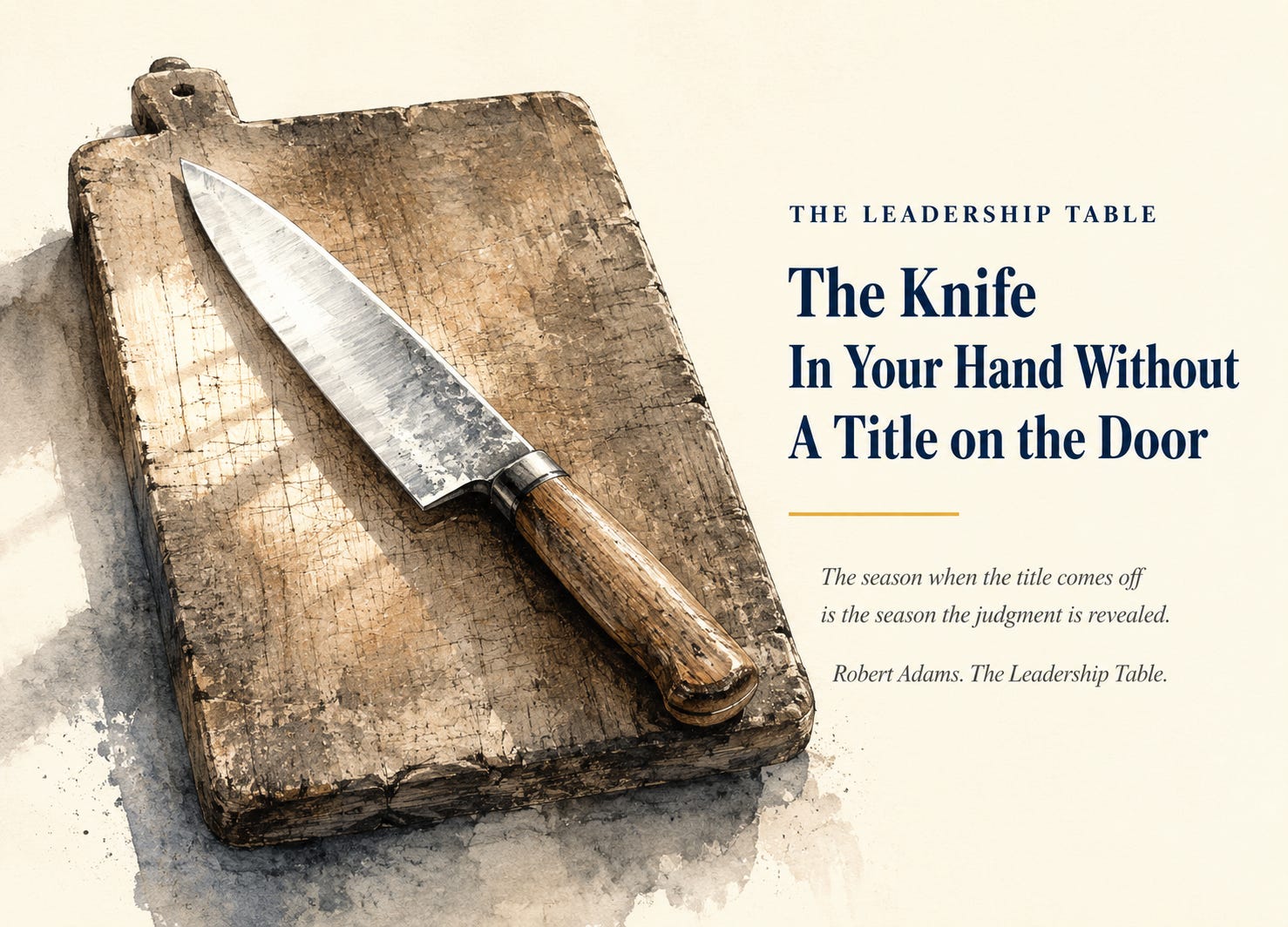
In the Place Setting Framework, The Knife is the third element. Judgment and precision. We covered The Knife in April with the work of having difficult conversations without casualties. The Knife returns now with a harder question. What does precision look like when you have no positional authority at all? When nobody has to listen to you, what makes them choose to?
This is pure Knife work. Reading the moment. Choosing the right edge. Knowing when to push and when to yield. Except now the handle has no title on it.
The Hardest Leadership in Any Organization
The hardest leadership work in most organizations does not happen at the top. It happens in the middle, where leaders have to influence sideways and upward without the structural authority to demand anything from anyone. The area director who needs eight different general managers to align on a service standard. The senior individual contributor who has to influence executives twice their level. The newer leader brought in from outside who has to earn the right to be heard before they can earn the right to lead.
Three decades in food distribution have taught me that the leaders who matter most in any organization are rarely the ones with the highest title. They are the people whose voice gets weight in the room because of what they have built without titular leverage. When they walk into a meeting, conversations shift. When they raise a concern, it gets considered. When they propose a direction, it gets followed.
That is not magic. It is built. And it is built by people who understood early in their careers that title-based leadership has a ceiling and that the leaders who go further than their title eventually permit are the ones who stop relying on titles to do the work.
Three Sources of Influence That Have Nothing to Do With Title
Center for Creative Leadership research on peer influence has documented this pattern across thousands of leaders over multiple decades. The leaders rated highest by peers as influential, regardless of formal authority, share three traits.
The first is genuine expertise. Not credentials. Expertise. The kind of knowledge that gets earned by doing the work and getting it wrong enough times to actually understand it. People defer to expertise because it is rare and because they recognize when they are talking to someone who has been somewhere they have not been. The leader who has been on the dock at three in the morning when a refrigerated truck went down has a different kind of authority on cold chain operations than the leader who has only read about it. That authority has nothing to do with their title.
The second is consistency. The same person in different rooms. The same standard applied whether the audience is a junior driver or a senior VP. The same response to a hard question whether the answer makes the leader look good or not. People follow consistency without being told to because consistency is rare and reading the leader becomes easier when they are the same in every context. Inconsistency is exhausting to track. People stop trying.
The third is genuine interest in other people’s success. This one separates real influence from political maneuvering. The leaders peers describe as genuinely influential are the ones who have invested in the success of people around them with no obvious return. They have shared knowledge. They have made introductions. They have given credit. They have flagged opportunities for someone whose career they had no business caring about. Over time, that investment compounds into a network of people who would step in front of a moving truck for them, and who tell other people they would do it. That kind of social capital cannot be bought, and it cannot be summoned in the moment. It is built one quiet investment at a time.
The Area Director Who Influenced Without Micromanaging
In food distribution, the area director role is almost entirely a study in influence without authority. The general managers running individual operations have their own P&Ls, their own teams, and a strong cultural sense that they are running their own buildings. The area director does not run their P&L. Does not hire their team. Does not handle their day-to-day. And yet has to align eight or ten of them on standards that affect the customer experience across the entire region.
The area directors who do this badly try to manage. They send checklists. They demand reports. They show up unannounced. They get tolerated. They almost never get followed.
The area directors who do this well show up to learn. They walk routes with drivers. They sit with sales teams during difficult customer conversations. They earn the right to be heard before they ask anyone to listen to them. When they finally do propose a direction, it lands because every GM in the room knows the area director has been in their building, knows what their actual constraints look like, and is not asking them to do something that someone in a corporate office invented. The proposal is taken seriously because the person making it has done the work to deserve a serious response.
That is The Knife without a title. Precision applied to the moment, but earned through the quiet work that happens long before the meeting where the influence is needed.
AI and the New Influence Currency
In an AI-augmented organization, this matters more, not less. As more operational decisions get automated, the work that remains for humans is increasingly the work of alignment, judgment, and buy-in. AI can route a delivery. AI can flag a margin issue. AI cannot get a senior leader to actually shift their position on a strategic question, or get a peer to commit to a different way of working, or get a junior team member to step up before they feel ready.
That work is leadership. It is influence work. And it does not depend on the title in the email signature. It depends on what the person has built with the people whose buy-in they need.
The leaders who matter most in the next decade will be the ones whose authority is independent of where they sit on the org chart.
The Play This Week
Ask one peer to teach you what they know.
Pick one peer or skip-level you do not directly manage. Identify a genuine point of expertise they have that you actually need to understand better. Ask them to teach you. Take notes. Apply something they said within the same week, and tell them what happened with it. That is influence built without authority and acknowledged in real time. It costs you twenty minutes. It compounds for years.
Friday’s Breaking Bread on LinkedIn takes the play and makes it operational before the weekend. It drops at 6:45 AM.
Episode 68 of A Student of Leadership drops tomorrow at 6:00 AM. It goes deeper on what title-free leadership actually looks like in food distribution and hospitality operations. Links in the show notes below.
Real Leaders. Real Growth. One Table.
Robert Adams
The Leadership Table
A title can move people, but it can't move their hearts. People aren't chess pieces; they're flesh and blood. Maybe that's why, in the end, it always comes down to one human to another.
When someone puts their time and effort into you, you find yourself wanting to do something for them in return. That, I think, is just how people are.