

The danger with AI is not that it makes bad decisions.
It is that it makes you stop making them.
Here is a finding worth sitting with. Organizations in 2026 are not short on AI tools. They are short on leaders who know what to do with them (Harvard Business Review, 2026). The bottleneck is not the technology. It is judgment. And judgment is the one thing we are quietly handing to the machine.
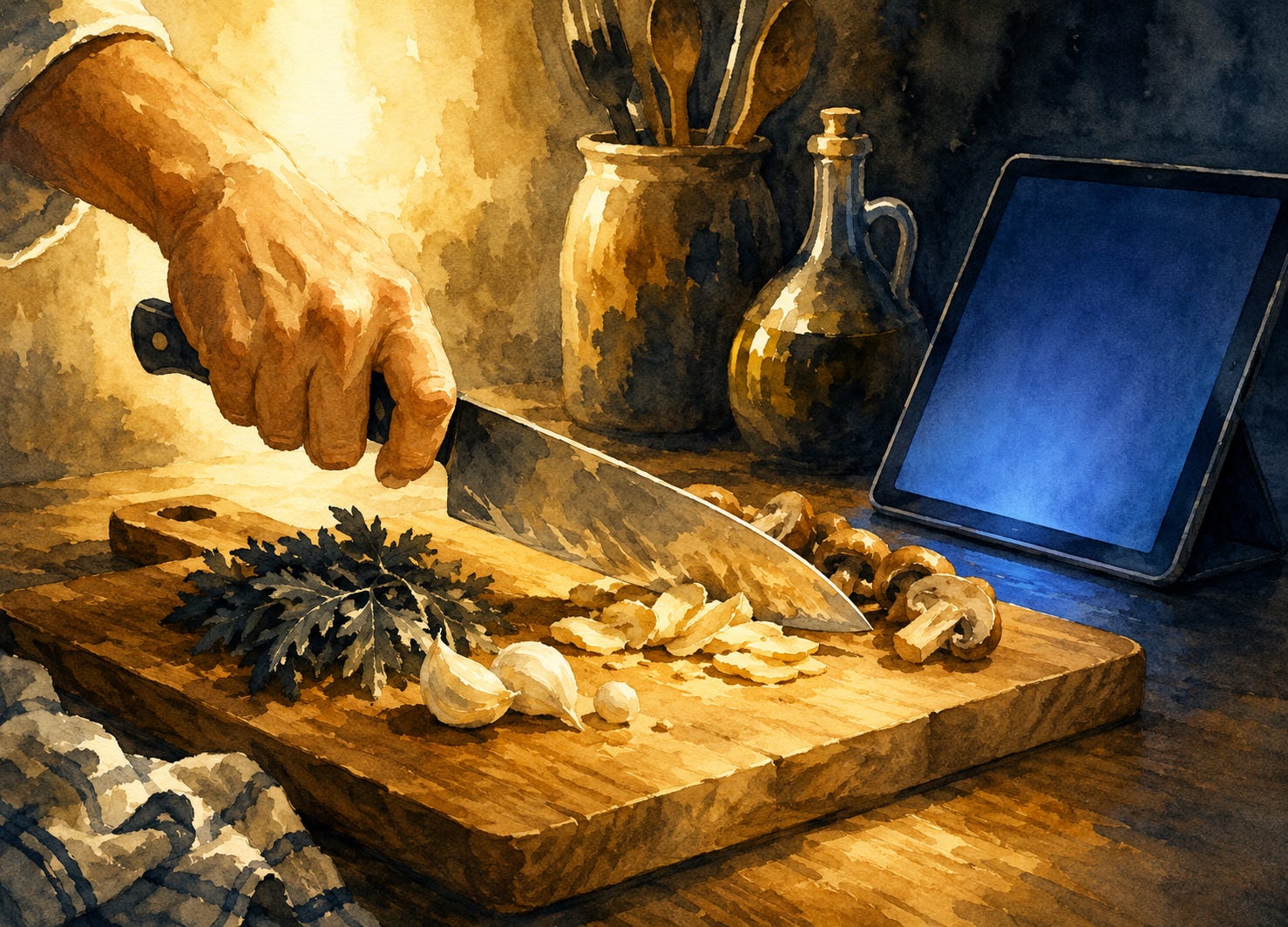
This is The Knife. Judgment and balance. The knife is the instrument of discernment, of separating, of the clean cut. Of all the elements, it is the one most exposed right now, because we have a tool that will happily make the cut for you, and it is very easy to let it.
Let me be fair to the tool first, because the foil only works if it is fair. AI is extraordinary. It will draft the hard email, model the scenario, surface the option you did not see, summarize the report in seconds. Use it. I do. A leader who refuses to use it is not principled, they are slow. Give the technology its full due.
And then notice the quiet thing it does to you.
Every time you let the tool make the call instead of make the case, a muscle softens. The first time, you ask it to draft a decision and you edit heavily. The tenth time, you skim and approve. The fiftieth time, you forward it without reading closely, because it is usually right and you are busy. That is not a technology problem. That is atrophy. The habit of judgment, weakening one convenient shortcut at a time.
Leaders gradually stop leading, defer to the system, trust the output without questioning it, and lose the habit of real judgment. It does not arrive as a decision. It arrives as a slow drift, and one day you realize you are not deciding anymore, you are ratifying.
Picture a chef who lets the inventory system decide every order. For a while it is efficient. Then a holiday weekend hits, a supplier fails, a local event the algorithm never heard of fills the dining room, and the chef who has not exercised judgment in months has nothing to fall back on. The tool was never wrong on the average day. It just quietly retired the skill the chef needed on the day that mattered.
There is a subtler version that catches even careful leaders. It is not that you ask the tool to decide. It is that you ask it to decide which decisions matter. You let it triage your attention, summarize what is urgent, tell you where to look. And slowly your sense of what is important is shaped by a system optimizing for what is legible to it, not what is consequential to you. The judgment you lose first is not the big call. It is the quiet upstream judgment about which calls are even worth your time.
What still matters most is exactly what AI cannot do. It cannot hold the relationship. It cannot carry the responsibility. It cannot initiate the conversation that the decision actually requires. It can give you a recommendation. It cannot give you the accountability for it. That part is yours, and it stays yours, and it gets sharper only if you keep using it.
There is also the question of who answers when the tool is wrong, and it is not small. When you make the call yourself, you own it. When the system makes it and you ratify it, you still own it, but now you own a decision you never actually examined. The accountability does not transfer to the machine. So the leader who defers to the tool is not reducing their risk. They are keeping all of the responsibility while giving away all of the understanding. That is the worst trade in leadership, and it happens quietly, one approved recommendation at a time.
The irony is that the leaders who use these tools best are the ones least afraid to set them aside. Confidence in your own judgment is what lets you take the machine’s output and say, useful, but no. The leader who has stopped deciding cannot do that. They have nothing to weigh the recommendation against.
And the people you lead are watching how you use these tools. If they see a leader who reaches for the machine before forming a view, that becomes the culture, fast. If they see a leader who thinks first and uses the tool to sharpen the thinking, that becomes the culture instead. You are not just protecting your own judgment. You are modeling, for everyone who works for you, what it looks like to stay in command of a tool instead of being led by it.
The Play this week: Make one real call before you ask the tool.
One decision that matters. You sit with it first. You form your own read. You write down what you would do and why. Then, if you want, you bring in the tool, to test your thinking, to argue with you, to find your blind spot. But you decided first. You kept the muscle working.
This is not anti-technology. It is the opposite. The leaders who will get the most out of these tools are the ones who keep their own judgment sharp enough to direct them. You cannot supervise a system you have outsourced your thinking to. And keep the relationship work in your own hands above all. The tool can draft the message to your team, the praise to your top performer, the hard note to the person who is struggling. It will be fast and fine and missing the one thing that made it matter, that you wrote it. People can feel the difference between a leader who chose their words and a leader who approved them. Some things should be slow on purpose, because the slowness is the message.
Let the tool make you faster. Do not let it make you passive. Keep your hand on the knife.
Friday’s Breaking Bread on LinkedIn takes one piece of this and makes it runnable before the weekend. It lands at 6:45 AM.
Real Leaders. Real Growth. One Table.
Robert Adams
The Leadership Table
https://theleadershiptable.net/

An important note for all my followers and subscribers:
Everything on Substack begins with my stories and lived experiences.
Thirty years of leading, failing, observing, studying.
AI helps me turn those ideas into sentences, and helps me find the right words when I know what I mean but can’t quite say it. Writing has been a lifelong struggle for me. I hope you respect that honesty, and the extra verified research and insight AI brings to help these thoughts land the way I mean them.