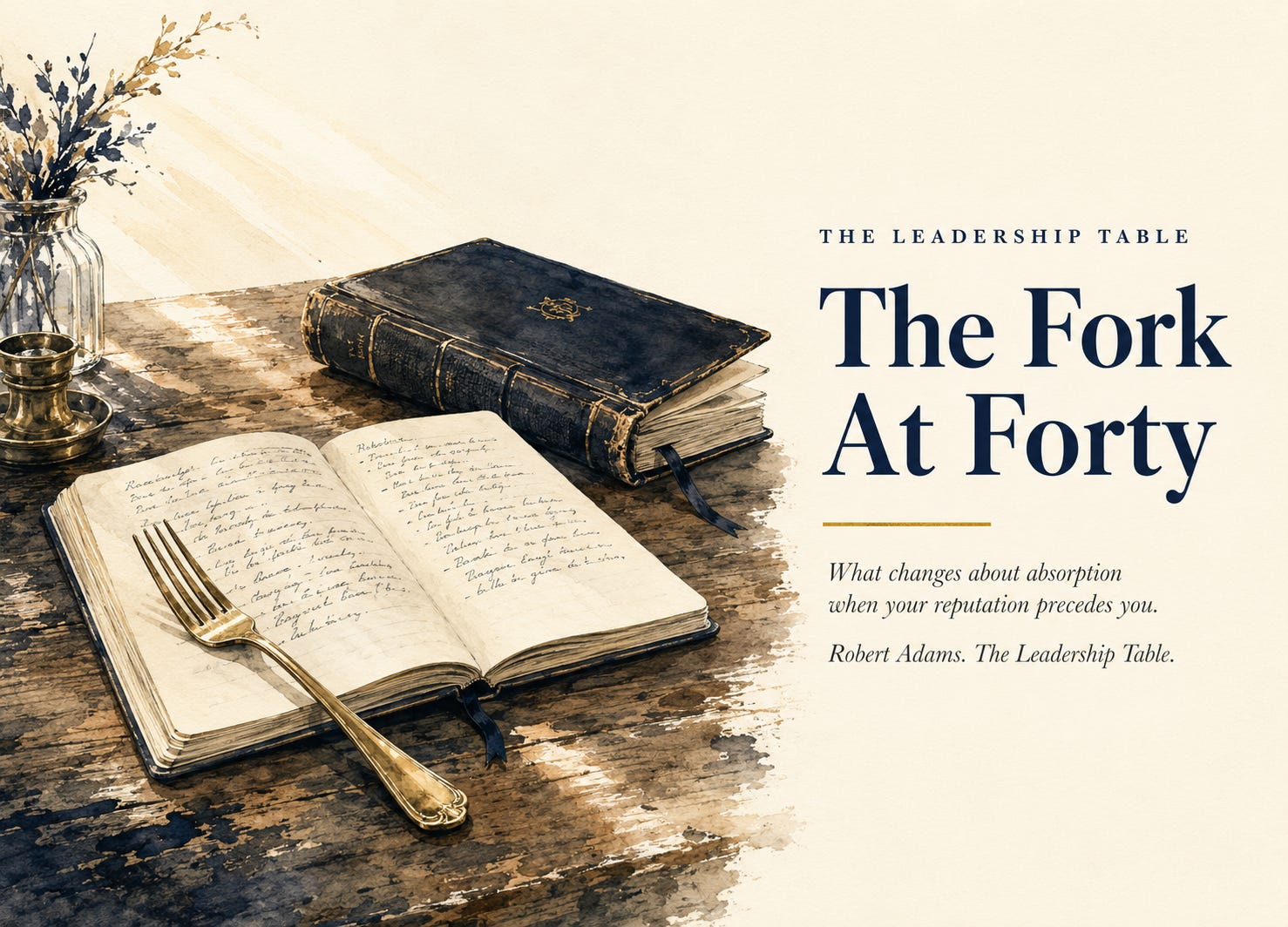
The Fork at Forty

Average leaders defend.
Great leaders absorb.
That is the entire difference, and almost everything else about how someone shows up in their leadership over time follows from it. The leader who absorbs feedback is building. The leader who defends against it is preserving. Building compounds. Preserving decays. Both happen quietly, week after week, in moments most people would not notice. By the time the difference becomes visible to everyone, it has been compounding for years.
In the Place Setting Framework, The Fork is the fourth element. Growth and choice. We covered The Fork in April with the daily acts that compound into something a team will follow. The Fork returns now with the harder question. What is the daily discipline that makes a leader keep growing, year after year, decade after decade, when most leaders eventually plateau and stop?
The answer is what they absorb. And specifically, what they absorb without their ego getting in the way of it.
The Conversation That Changed Everything
In 2018, I went through Marshall Goldsmith Stakeholder Centered Coaching certification. I had been leading for over twenty years at that point. I had been promoted multiple times. I had a team of leaders working for me who consistently performed. I genuinely thought I was good at receiving feedback.
The certification process disabused me of that notion within the first week.
Goldsmith’s methodology is simple in design and brutal in practice. You identify a small group of stakeholders, the people who actually see your leadership in action, and you commit to a behavioral change. Then you ask them, monthly, for one specific suggestion on what you could do differently to improve in that area. Not feedback on what went wrong. Suggestions for what to do next. The shift from feedback to feedforward.
The first month I tried it, I asked the question and I started defending almost before the person had finished their sentence.
Not visibly. Not aggressively. Internally. I would hear the suggestion and immediately, automatically, frame all the reasons it was not quite right, did not understand the full context, missed something important. By the time I responded, I had constructed a polite acknowledgment that was essentially a refusal. The person walked away, and I went back to doing what I was already doing.
Goldsmith’s data on this pattern is extensive. He has documented over decades that the single biggest predictor of whether a leader actually changes a behavior is not their commitment, their goals, or their stated intent. It is their ability to receive a suggestion without defending against it.
That was the moment my own development as a leader actually began. Not the moment I got certified. The moment I realized that for two decades I had been performing receptiveness while my actual posture was defense. Two decades of perfectly polite responses that produced almost no behavioral change.
What Average Leaders Reject
Average leaders are not bad people. They are people who have built defenses against the kind of input they would actually need to absorb to keep growing.
They reject suggestions that came from someone they outrank. The thinking goes: that person does not see what I see, so their input is not relevant. The mathematics of organizational hierarchy quietly become the mathematics of who gets listened to. Suggestions from above get weighed. Suggestions from below get filtered. Eventually they get tuned out entirely.
They reject suggestions that contradict a previous commitment. If a leader has publicly held a position, suggestions that imply the position needs adjustment trigger ego protection. The integrity of the previous statement becomes more important than the quality of the new direction. Pride buys time but charges interest.
They reject suggestions that imply gaps. The harder a leader has worked to look like they have it figured out, the harder it becomes to absorb feedback that suggests there is something they have not figured out yet. The very competence that got them to leadership becomes the obstacle to deepening the leadership once they are there.
What Great Leaders Absorb
The leaders I have watched continue growing well into their fifties, sixties, and beyond share a common trait. They have removed almost all of the friction between someone offering them an honest input and that input actually changing their behavior.
They ask. Not as a performance. Repeatedly, in real conversations, with real specificity. “What is one thing I could do differently next quarter that would make me more effective for you?” That question costs them nothing and gives them everything. Most leaders ask it once at the annual review and forget it for eleven months. The leaders who keep growing ask it constantly.
They thank without defending. The single discipline that separates absorption from rejection is the ability to receive a suggestion and respond with thank you, without any explanation attached. The explanation is the defense. Even a polite explanation is a defense. The discipline is to receive, register, and act, without performing analysis on whether the input was perfectly correct in every detail.
They follow up. The completion of feedforward is closing the loop. The leader who asks for a suggestion, runs it, and reports back what came of it has built something extraordinary. The person who gave the suggestion now has evidence that being honest with this leader is worth the discomfort. They will give honest input again. And again. And the leader will keep getting better.
That loop, repeated over decades, is what produces the leaders who never quite stop developing.
AI and the Mirror Problem
AI is genuinely useful at giving leaders fast, accurate feedback on data. Performance metrics. Sentiment analysis. Pattern recognition. What AI cannot do is tell a leader the truth about themselves.
The truth about a leader is held by the people they impact. The team member who notices the pattern of who gets credit. The peer who watches what happens when something goes wrong. The direct report who sees what gets prioritized when calendars get tight. AI does not have that vantage point. People do. And only the leaders who have built the discipline of asking those people what they are actually seeing get the benefit of that mirror.
The other leaders look at the mirror AI offers them, see what they want to see, and miss what is actually there.
What feedback have you been quietly resisting?
The Play This Week
Run the feedback you have been quietly resisting.
Pick one piece of feedback you have been quietly resisting. The one you keep explaining away in your own head. Find the person who gave it. Ask them for one specific suggestion on what you could do differently in that area. Receive it without defending. Run it this week. Then go back to that person, tell them what you tried, and tell them what happened.
That is feedforward in practice. That is The Fork at its second pass. That is the discipline that compounds for the rest of a leader’s career.
This week’s Play was: Run the feedback you have been quietly resisting.
Friday’s Breaking Bread on LinkedIn takes the play and makes it operational before the weekend. It drops at 6:45 AM.
Episode 69 of A Student of Leadership drops tomorrow at 6:00 AM. It goes deeper on the Goldsmith methodology and on what the shift from feedback to feedforward looks like in practice. Links in the show notes below.
Real Leaders. Real Growth. One Table.
Robert Adams
The Leadership Table