
The Conversation
You Cannot Outsource

The conversations leaders postpone do not disappear.
They accumulate. They compound. They develop their own gravity. And by the time the leader is finally ready to have them, the conditions that would have made them productive have changed, the trust that would have made them survivable has eroded, and the cost of having had them late is significantly higher than the cost of having had them on time.
Almost every senior leader I have coached over the last several years has at least one of these conversations sitting on their internal docket. Some have several. Most can name the specific person and the specific topic. Most can describe, in detail, why they have not had it yet. And most know, when pressed, that the reason for postponing it has never been that the right time has not arrived. The reason has always been that having it costs the leader something, and the leader has decided to keep paying the smaller cost of postponement instead of the larger cost of resolution.
This is the leadership work that does not get automated. It does not get delegated. It does not get optimized. It does not get scheduled around. It just sits there until the leader walks into the room.
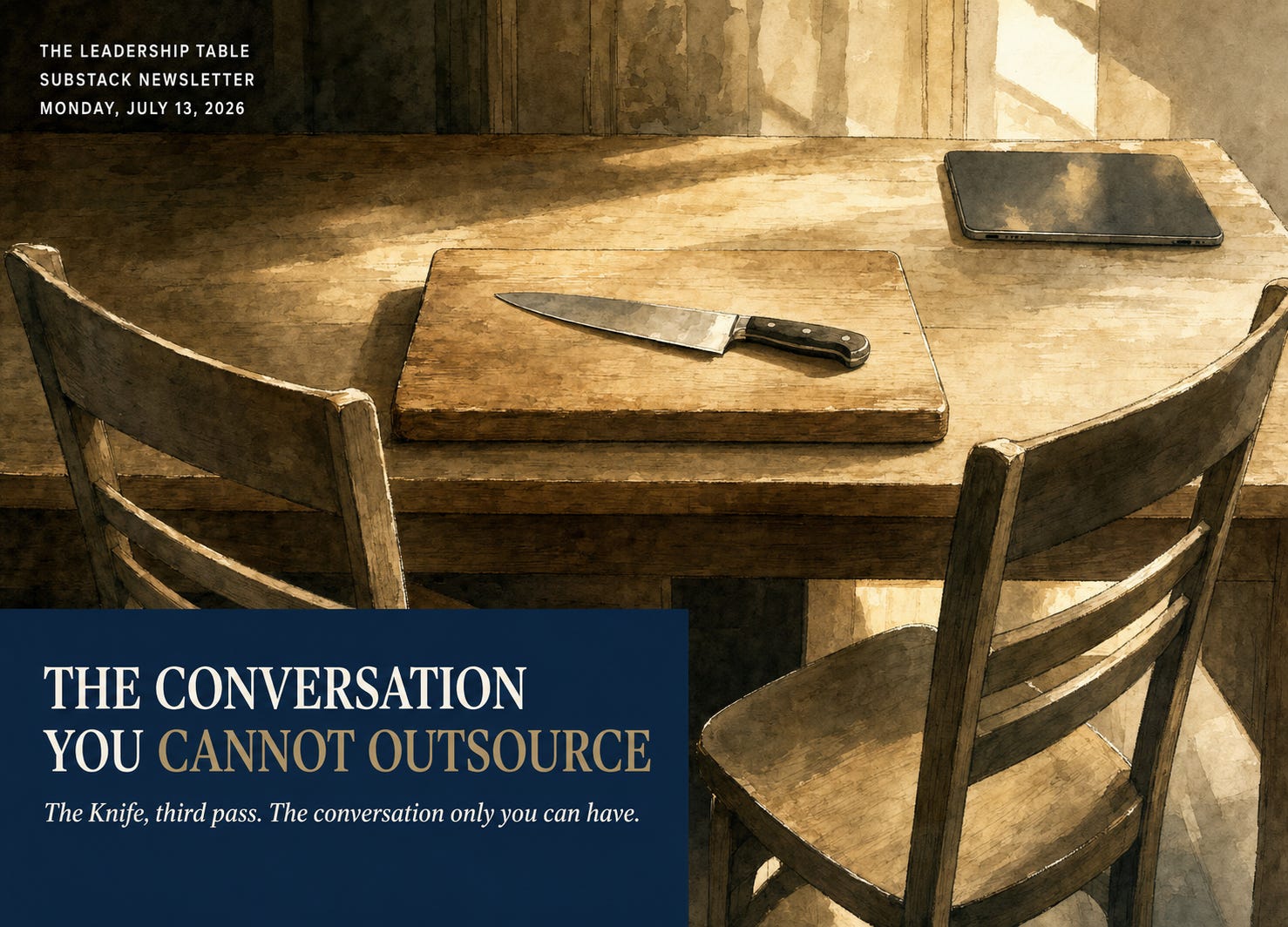
In the Place Setting Framework, this is The Knife. Judgment and Balance. The conversation that lands depends on the leader holding the right edge in the right moment, and that capability is exclusively human, exclusively earned, and exclusively the leader’s to bring.
The Conversations Most Leaders Are Sitting On
Across coaching practice and three decades of food distribution leadership, the same five conversations keep surfacing on senior leaders’ internal dockets. None of them are dramatic. All of them are postponable. Each one of them costs significantly more to postpone than to have.
The honest performance conversation with a long-term contributor whose performance has been slipping. The leader can see it. The team can see it. The contributor probably knows. The leader has been hoping the situation will resolve itself, that a new project or a different team configuration will quietly move the problem somewhere else. It will not. The conversation is the only thing that will. And the longer the leader waits, the more the rest of the team learns what the leader is willing to tolerate, which becomes its own slow erosion of the standard.
The conversation with a peer about a behavior that is creating problems for both teams. The pattern is observable. The impact is measurable. The peer is not actively malicious. The path of least resistance is to work around them, brief the team to manage their inputs, and route around the friction. The cost of working around a peer compounds. The cost of one direct, well-prepared conversation is finite.
The conversation with a senior leader above you whose direction is producing outcomes that are clearly not working. The dynamic of the org chart makes this conversation feel impossible. It is not impossible. It is hard. And it is the kind of conversation that distinguishes leaders whose authority is independent of their position from leaders whose authority depends entirely on someone else granting it. Senior leaders who never push up never lead in any meaningful sense.
The honest conversation with a high-potential team member about what is actually getting in the way of their next promotion. The leader has been giving them encouragement instead of feedback. They are confused, plateaued, and starting to look elsewhere because the next step they were promised is not materializing and nobody has been willing to tell them the truth about why. The hardest version of investment is the version that involves saying something the person did not want to hear.
The conversation with yourself about a commitment you made publicly that you can now see clearly was wrong. Most leaders will not have this one because admitting they got it wrong, even to themselves, feels like it costs them credibility. The leaders I have most respected over thirty years have all been able to have this conversation, name the change in direction, and absorb the short-term credibility hit because the alternative, doubling down on a wrong commitment, costs more.
Why AI Will Not Solve This
AI can prep you for these conversations. It can help you draft talking points. It can pressure-test your framing. It can summarize the relevant facts and surface relevant patterns from the data.
What AI cannot do is have the conversation.
The conversation requires presence in the room. It requires the leader’s ability to read the moment, hold the standard, and modulate based on what they are actually seeing and hearing in real time. It requires the relational capital that the leader has built or failed to build with the person on the other side of the table. It requires the leader’s willingness to be uncomfortable, to be wrong about something they predicted, to be moved by a piece of context they did not have, and to keep the larger purpose visible while the smaller details are being negotiated.
That is leadership work. It is not delegatable. It is not optimizable. It is one of the few categories of work where the leader’s actual presence is the deliverable.
The leaders who avoid these conversations are not avoiding because they are weak. They are avoiding because the conversation costs them something. Time, comfort, certainty, the appearance of strength. Each cost is real. The cost of postponement is also real. The mistake is in believing the costs are not symmetrical when they are.
What the Conversation Itself Looks Like
Three patterns separate productive hard conversations from the postponed ones.
The leader who opens with what they observed, not what they concluded, lands the conversation. “I have noticed three meetings in a row where the prep was not at the level I usually count on from you” lands. “Your performance is slipping” does not. The first invites response. The second triggers defense. Same content. Different conversation.
The leader who ends with the future, not the past, gets traction. “What can we do, starting this week, to get the prep back where it needs to be” produces commitment. “Let’s talk about what went wrong with the last three meetings” produces explanation. The first is forward-facing. The second is backward-facing. The first builds. The second relitigates.
The leader who does not soften the ask, but does soften the delivery, gets the result. The standard is firm. The tone is human. Most leaders get this exactly backwards. They soften the standard to make the conversation easier and harden the tone to compensate. The result is a conversation that is unpleasant to have and does not produce the change they needed.
The Play This Week
Identify the one conversation you have been outsourcing to time. Not the one you would have if you had to. The one you have been carrying for weeks, months, possibly years. Pick that one. Schedule it for this week. Not next month. This week. Open with what you have observed. Close with the future. Hold the standard. Let the tone be human. The conversation does not get easier with delay. It gets larger.
Friday’s Breaking Bread on LinkedIn takes the play and makes it operational before the weekend. It drops at 6:45 AM.
Episode 73 of A Student of Leadership drops tomorrow at 6:00 AM. It goes deeper on the five common conversations leaders postpone, the three patterns that distinguish productive from unproductive ones, and what AI can and cannot do for any of it. Links in the show notes below.
Real Leaders. Real Growth. One Table.
Robert Adams
The Leadership Table
Robert, this is one of the few responsibilities leaders simply cannot delegate. Difficult conversations aren't just about resolving an issue, they're about protecting trust, reinforcing standards, and demonstrating the kind of culture the organization wants to create. Every postponed conversation quietly sends a message, whether intended or not. I've found that the most effective leaders prepare carefully, lead with curiosity, communicate honestly, and keep the focus on future improvement rather than past blame. The conversation may be uncomfortable, but avoiding it almost always costs more than having it.
Really enjoyed reading this! It’s important to act before its too late or the sense of urgency becomes too strong!!