
The Conversation Your Team
Is Already Having Without You

Avoiding conflict does not protect the relationship.
It delays the damage. And it compounds interest on the way down.
I have watched this play out in food distribution operations more times than I can count. A manager who knows there is a problem on his team, has known for weeks, and keeps waiting for the right moment to address it. Waiting for things to slow down. Waiting for the quarter to close. Waiting until the conditions are better and the timing is right.
The conditions are never better. The timing is never right. And while the leader waits, the team does not.
The conversation you keep avoiding is already having itself. Just without you in the room.
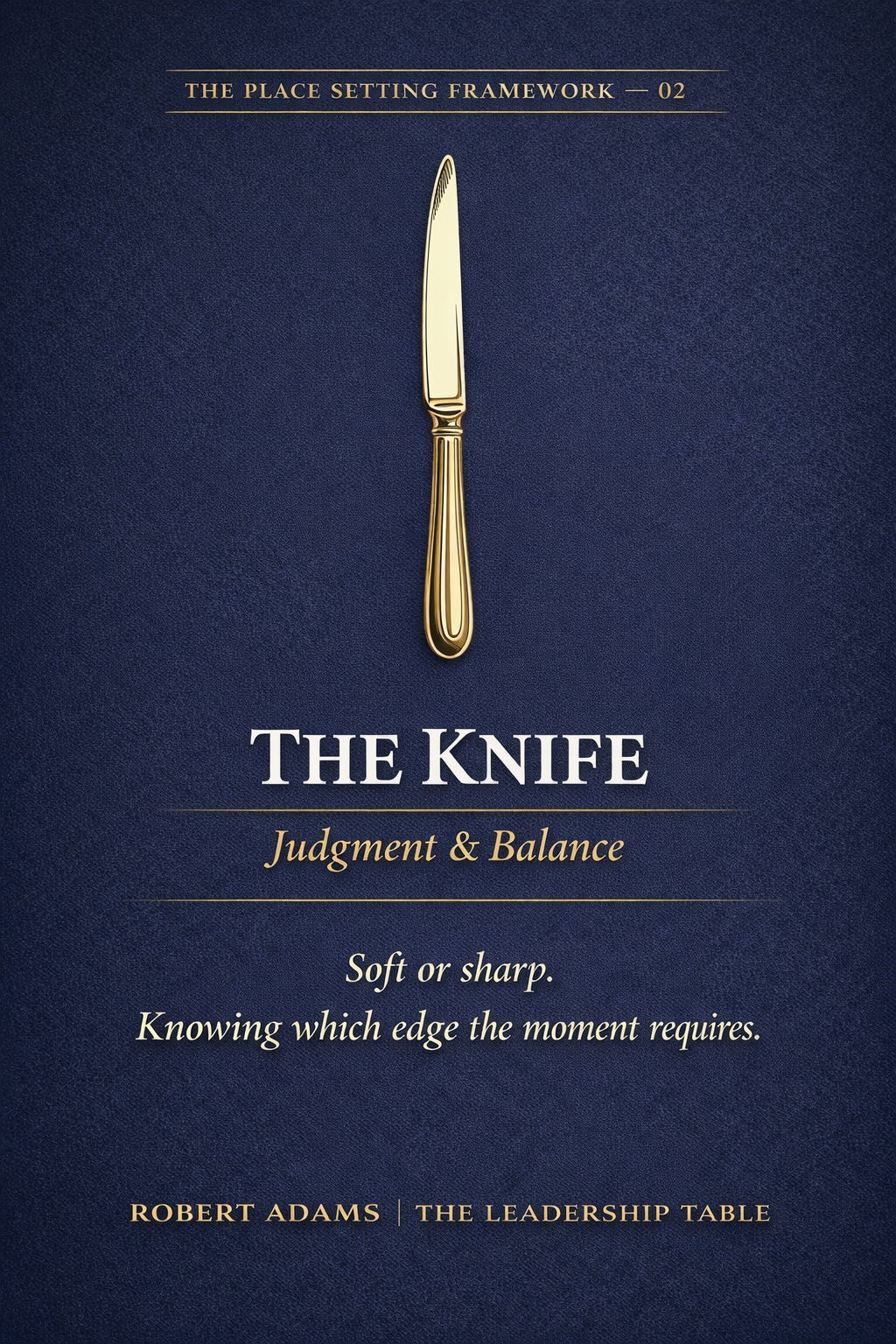
In the Place Setting Framework, The Knife is the third piece. It is the element most people misread. They hear the word knife and think aggression. They think about being direct to the point of being harsh, about cutting through, about leaders who pride themselves on telling it like it is regardless of the damage it leaves.
That is not what the knife is.
A knife used well is one of the most precise tools at a table. A skilled chef does not swing a knife. They control it. They understand the difference between a blade that slices cleanly and one that tears. The value of the knife is entirely in the judgment of the person holding it. And the knife is set correctly with the blade facing inward, toward the plate, toward the work. Not outward. Precision directed at the problem, never at the person.
That distinction is everything.
Two Edges, One Discipline
The knife has two edges. Most leaders default to one and call it their style.
The avoiders use the soft edge every time. They tell themselves they are being patient, being kind, giving the person space. What they are actually doing is choosing their own comfort over their team’s clarity. And the team reads that clearly. Standards soften. Accountability becomes selective. Trust erodes not in a single dramatic moment but in the accumulated weight of conversations that never happened.
The escalators use the sharp edge every time. Directness without judgment. Force without precision. The team learns quickly that the environment is unsafe, that mistakes get magnified, that being visible carries risk. They stop bringing problems forward early. They start managing their exposure instead of doing their best work.
Neither edge is the wrong one. Both edges are necessary. The discipline, the real leadership discipline, is knowing which moment requires which response.
When someone needs support, when trust needs space to grow, when a mistake is a teaching moment rather than a pattern to correct, use the soft edge. When a standard is being quietly abandoned, when drift has become dangerous, when something needs to be named and addressed clearly, use the sharp one.
My mother knew this instinctively. She was one of the warmest people I have ever known. She also did not lower her standards for the convenience of the moment. She knew when to be soft and when to be sharp. She never had a framework for it. She just had thirty years of paying attention to people and what they actually needed from her.
The Four-Step Precision Approach
When the moment calls for the sharp edge, here is what precision looks like in practice.
Step one is stepping toward it. Not waiting for the right moment. Not hoping the problem resolves itself. The right moment is now, or as close to now as your next scheduled conversation allows. Every week you wait, the team draws more conclusions from your silence. Those conclusions are almost always worse than the conversation would have been.
Step two is naming it clearly. Specific and behavioral. Not “there has been some tension lately.” Tell them what you observed, when it happened, and what the impact was on the team or the work. Ambiguity is not kindness. It is confusion. And confusion does not change behavior.
Step three is separating the person from the pattern. You are addressing what has been happening, not who they are. This is the distinction that determines whether someone walks out of a hard conversation ready to change or ready to defend themselves. A person who feels attacked shuts down. A person who feels respected and clearly corrected has somewhere to go.
Step four is closing with belief. After you have addressed the issue, you tell them what you believe about their ability to move forward. Not to soften the message. Because if you did not believe in them, you would not be having the conversation. You would be managing them out. The close with belief is what makes a hard conversation an investment instead of a verdict.
The hard conversation delivered with precision is one of the most caring things a leader can do.
The Data Behind This
Emtrain’s 2025 Workplace Culture Report documented a 10 percent increase in workplace conflict last year. It is getting harder in most organizations, not easier. And in high-pressure environments like food distribution and restaurant operations, where crews are stretched, margins are thin, and people are working hard in conditions that do not leave much room for ambiguity, the leaders who navigate conflict well are the ones whose teams stay.
The ones who avoid it are not protecting their teams. They are running up a debt they will eventually have to pay.
What This Week Looks Like
On Tuesday, Episode 61 of A Student of Leadership goes deeper on the Knife framework and the specific moves that turn a hard conversation from a liability into a leadership act. That episode drops at 6:00 AM on Apple Podcasts and Spotify.
Links in the show notes.
Friday’s Breaking Bread on LinkedIn takes the practical core of this week and makes it something you can use before the weekend. It drops at 12:45 PM.
Here is the question worth carrying into this week: What conversation is your team waiting for you to have?
You already know which one. They already know too.
Step toward it.
Real Leaders. Real Growth. One Table.
Robert Adams
The Leadership Table
Seems like we are on the same page today. Conflict can be seen as a necessary evil or as an opportunity for growth.