
Stop Looking in the Rearview Mirror

For most of my career, I thought feedback was the only tool.
Someone needed to grow. You told them what they had done wrong. You explained what they needed to do differently. You hoped the conversation landed. Most of the time, it did not. Or it landed badly. And the person walked away from it feeling defended rather than developed.
I did not have a different framework. I did not know there was one. Feedback was the instrument everyone used and so I used it too. What I could see in the rearview mirror of someone’s performance, I pointed out and called it leadership.
Then I came across the concept of feedforward and the entire lens changed.
The Rearview Mirror and the Windshield
Here is the image that shifted how I think about this.
A rearview mirror is small. It shows you a narrow slice of what is already behind you. The road you have already traveled. The events you cannot change. The decisions that are already made.
A windshield is vast. It shows you everything ahead. The direction you are heading. The possibilities that exist in front of you. The road that has not been driven yet.
Most traditional feedback is a rearview mirror conversation. You are showing someone what is already behind them. They cannot change it. They can only feel the weight of it. And the natural human response to that weight is to get defensive. To protect. To explain. To justify. Not because the person does not want to grow but because looking backward with someone pointing at your errors does not feel like development. It feels like an evaluation.
Feedforward is the windshield conversation. Instead of asking what did you do, it asks what could you do. Instead of pointing at what happened, it points at what is possible. Instead of assigning a verdict, it opens a door.
That distinction changed how I lead. It changed how I coach. And in my experience, it changes how people receive the investment a leader is trying to make.
How I Used to Give Feedback
I was a direct report manager for a long time before I understood this. And I can tell you exactly what my feedback conversations looked like before feedforward.
Someone would do something I needed to address. A pattern of behavior that was not working. A gap between what I expected and what was being delivered. I would sit down with that person and I would tell them what I had observed. I would describe what had happened. I would explain why it was a problem.
Every time I did that, the person across from me went into defense mode. Not because they were not capable of hearing the truth. Because the truth I was delivering was about something they could not change. It was already done. The only place to go with backward-facing information is backward.
When I started shifting the language, everything changed.
Instead of pointing at what had already happened, I started saying: the next time this situation comes up, I would like to see more of this. I would like to see less of that. When this occurs, here is what I am hoping your response looks like.
That is feedforward. Looking ahead. Giving someone something they can actually do with the information. And when you do it that way, the person does not get defensive. There is nothing to defend. You are talking about the future. They have full agency in the future. They do not put their guard up. They lean forward.
The Stakeholder Piece
The other dimension of this that changed how I think about leadership development is understanding who holds the most accurate picture of a leader’s actual behavior.
It is not the leader. Not even close.
The people with the most accurate picture of how a leader is actually showing up, not how they think they are showing up, are the people they impact and influence every day. Their direct reports. Their peers. Their own leader.
Those stakeholders are observing the behavior. They are experiencing the impact. They are the ones who know, in real time, what is working and what is not. And most of them will never say so unless a structure exists that makes it safe and useful to do so.
The approach I use with the leaders I coach involves those stakeholders directly. Looking back at the last thirty days: what have you actually observed this leader doing? Not evaluating their intent, their character, or their future potential. Just what they observed in their behavior. And looking forward at the next thirty days: what is one thing this leader could do that would have positive impact on you and the team?
That two-part question, backward at behavior and forward at possibility, gives a leader something remarkably useful. It grounds the development work in reality rather than self-perception. And it connects the leader to the people who have the most at stake in their growth.
You are not developing yourself in isolation. The people around you are the best measure of your progress.
A Cloudy Glass
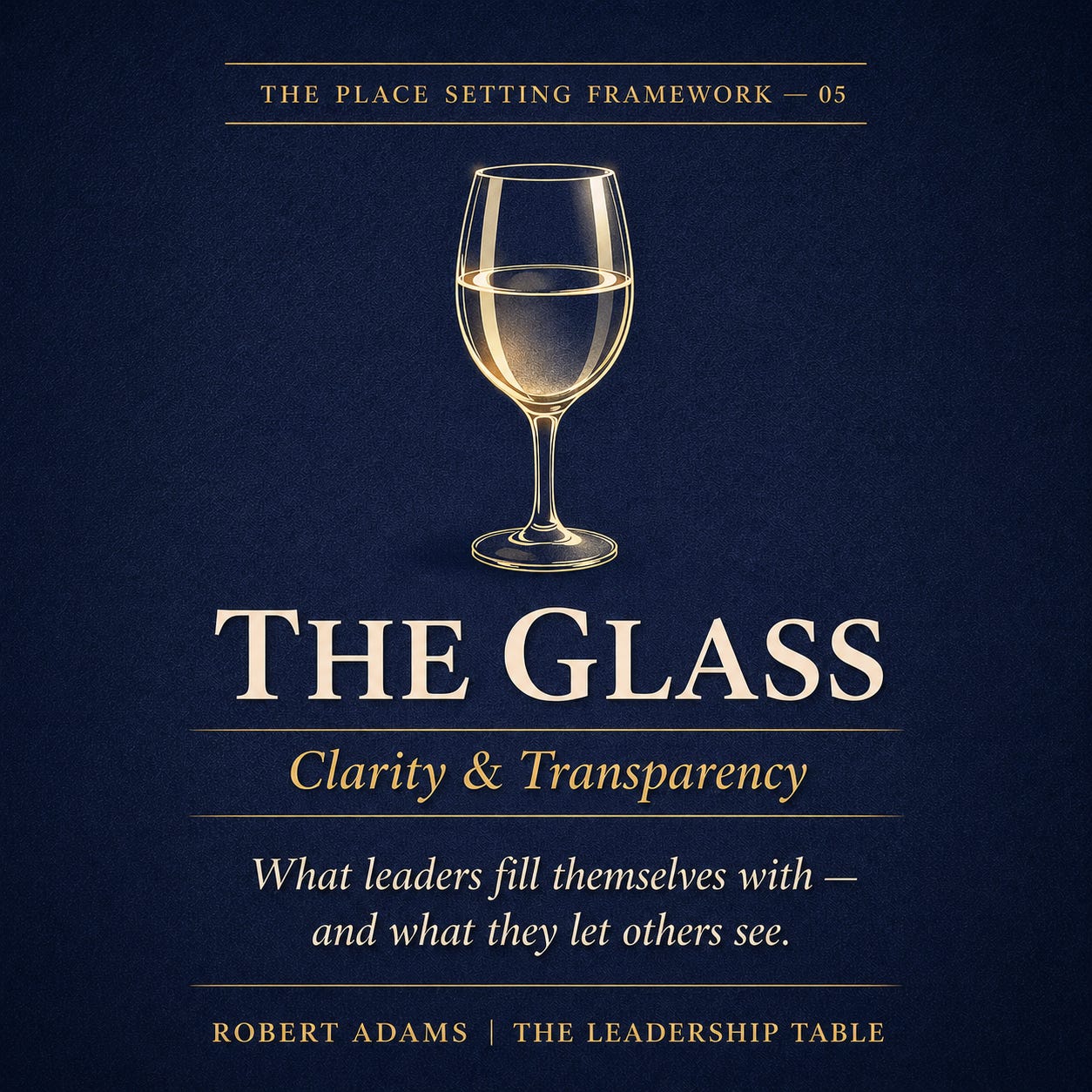
In the Place Setting Framework, The Glass is about clarity and transparency. What leaders fill themselves with and what others can see through them. A cloudy glass cannot show anyone the way.
Most leaders believe they are clear when their teams experience them as opaque. The gap between how clearly a leader thinks they are communicating and how clearly their team receives that communication is one of the most consistent findings in leadership research.
Feedforward is a way to clean the glass. To get an accurate picture of what is actually visible to the people around you, not just what you intend to project. And to give them the information they need to see a clearer version of what is possible ahead.
AI can provide feedback in real time through performance dashboards, communication analysis, and sentiment tools. What it cannot do is create the relational safety that makes feedback worth giving and feedforward worth receiving. That safety is built by a leader. One conversation at a time.
This week on A Student of Leadership, Episode 64 goes deep on the feedforward conversation, the stakeholder piece, and the specific language that changes how development lands. Link in the show notes.
Friday’s Breaking Bread has the one practice worth trying this week. It drops at 12:45 PM.
The question worth carrying: who are the stakeholders in your leadership right now, and when did you last hear from them about what would make you more effective?
Real Leaders. Real Growth. One Table.
Robert Adams
The Leadership Table
What a great way to look at it, figuratively with your metaphor. I've been a part of some rear view mirror focus l conversations. Pretty easy to have now with all the tracking systems we have.