
My mother never called it leadership.
She called it living.

She set a table every day. I spent thirty years learning what she was actually doing.
Most leadership frameworks were built in conference rooms.
This one was built in a kitchen.
Before thirty years in food distribution. Before the coaching certifications. Before boardrooms and strategies and performance metrics. There was a table. And a woman who sat at it and led without ever using the word.
My mother ran a catering business. She cared for aging parents who moved into our home when they could no longer care for themselves. She carried a family through hard seasons with limited means and unlimited character. She showed up every single day. Not with speeches. Not with strategies. With something far more durable.
Presence. Standards. Love that held people accountable. Strength that never required an audience.
I watched her set a table every day of my childhood. It was not ceremonial. It was intentional. Everything had a place. Everything had a purpose.
Thirty years later, I finally understood what she was doing.
I call it The Place Setting Framework: seven dimensions of leadership that cannot be faked, cannot be outsourced, and cannot be skipped. Together, they form a leader people trust, follow, and become better for knowing.
Here is the complete setting.
Leaders are not born at a podium. They are formed at a table. Piece by piece. Day by day. Choice by choice.
---
The Plate: Foundation and Character
Everything else sits on this. If it cracks, everything falls.
Character is not one thing on a list of leadership qualities. It is the surface that holds everything else. Without it, skills slip. Frameworks fail. Strategy evaporates under pressure. With it, even an imperfect leader earns trust, because people can feel what is underneath.
The Plate does not move. It does not bend for convenience. It does not show one face in the all-hands meeting and another in the hallway afterward. The foundation is either solid or it is not. The people you lead will know the difference long before you do.
My mother never negotiated the terms of her response to difficulty. When her parents needed care, she stepped up. Quietly. Consistently. Every single day. She had built the foundation long before the weight arrived. So when it came, the plate held.
Reflection: When nobody is watching and there is no recognition, no review, no audience, what does your plate look like?
---
The Knife: Judgment and Balance
Soft or sharp. Knowing which edge the moment requires.
The knife at the table is not a weapon. In the hands of someone who knows how to use it, it does exactly what is needed. No more, no less. It knows the difference between cutting what does not serve the meal and slicing what would.
Leaders carry this every day. The judgment to know when to push, when to hold, when to address the tension in the room, and when to let it settle.
A knife fails in two ways. The first is obvious: aggression, the blade deployed too hard, too fast, with too little care. The second is less visible and equally damaging: avoidance. The knife that never gets used. The tension that never gets addressed. In distribution centers and kitchens, this second failure is epidemic. Operational culture rewards people who keep things moving over people who stop to address what is actually wrong.
Reflection: What are you walking past right now, and what is your team paying for it?
---
The Fork: Absorption and Growth
What you take in shapes how you lead. Intake with intention.
The fork is the most used piece of silverware at the table. Not the most dramatic. Not the most decorative. The most necessary. It shows up every day. It does its work without announcing itself. Its value is entirely in repetition and intention, not ceremony.
Leaders grow from what they absorb. The ones who stop absorbing stop growing. The ones who absorb indiscriminately are pulled apart by too many inputs with no filter.
I have watched leaders in food distribution build long careers on a single discipline: they absorbed every experience deliberately. Feedback sought, not waited for. Observation from the floor, not the office. Time set aside for reflection when everything else screamed for reaction. The difference between thirty years of growth and one year of experience repeated thirty times? The fork. Used with intention. Every day.
Reflection: What are you actually absorbing right now, and is it making you a different leader or just a busier one?
---
The Spoon: Nourishment and Development
What you pour into others. Giving without keeping score.
The spoon is the most selfless piece at the table. It does not take in. It pours out. It gives what it carries to others without keeping score of what it gave last time or calculating what it might receive in return.
Leadership development is the spoon dimension. Not the performance review. Not the annual training day. The daily investment in someone else’s growth without attachment to what you get back. The leader who takes five minutes after the shift to debrief with a struggling team member when they could have gone home. The one who gives a stretch assignment to someone who is not quite ready yet because they believe in where that person is going.
Here is what separates The Spoon from the others: it requires a full plate first. You cannot pour from an empty spoon. Leaders who have burned through their own capacity eventually serve nothing of value, regardless of how committed they feel.
Reflection: Who are you developing right now, not because it benefits you, but because you believe in where they are going?
---
The Glass: Clarity and Transparency
What leaders fill themselves with. And what they let others see.
A cloudy glass cannot show others the way. Neither can a cloudy leader.
The Glass is what leaders fill themselves with, and what others can see through them. Clarity as internal discipline: knowing what you believe, why you believe it, and what you are willing to stand behind regardless of who is asking. Transparency as external standard: letting people see your reasoning, your uncertainty, and your conviction, not just your conclusions.
In thirty years, the leaders who lost their teams most quietly were rarely the dishonest ones. They were the unclear ones. The ones whose teams never quite knew where they stood. Who gave feedback that circled the issue without landing on it. Who spoke about values in all-hands meetings and then made decisions that contradicted them without explanation.
A glass that is cloudy does not look broken. It just looks off. People keep using it, but they stop trusting it.
Reflection: If your team had to describe your values based on your decisions, not your words, would they be able to?
---
The Napkin: Dignity and Presence
How you treat people when nothing is required. The detail that reveals everything.
The napkin is the finishing detail. Nobody leads with it in a performance review. It is the last piece placed, the quiet act of someone who considers every detail a statement.
In leadership, The Napkin is how you treat people in the moments when nothing is required. No performance benefit. No audience. No consequence. How you speak to the person at the bottom of the org chart. Whether you remember the name of someone’s child. Whether you address a mistake directly and with dignity, or let it fester into a story the team tells about you for years.
The napkin protects. Leaders who protect people’s sense of worth, even in conflict, even in failure, build something no compensation package can replicate. They build people who would do almost anything for them, not because they have to, but because they feel seen.
My mother placed the napkin before anyone sat down. Not because anyone would have noticed if she had not. Because she would have known. That is the standard.
Reflection: How do you treat people in the moments that do not count, the ones nobody is watching, and what does that reveal about who you actually are?
---
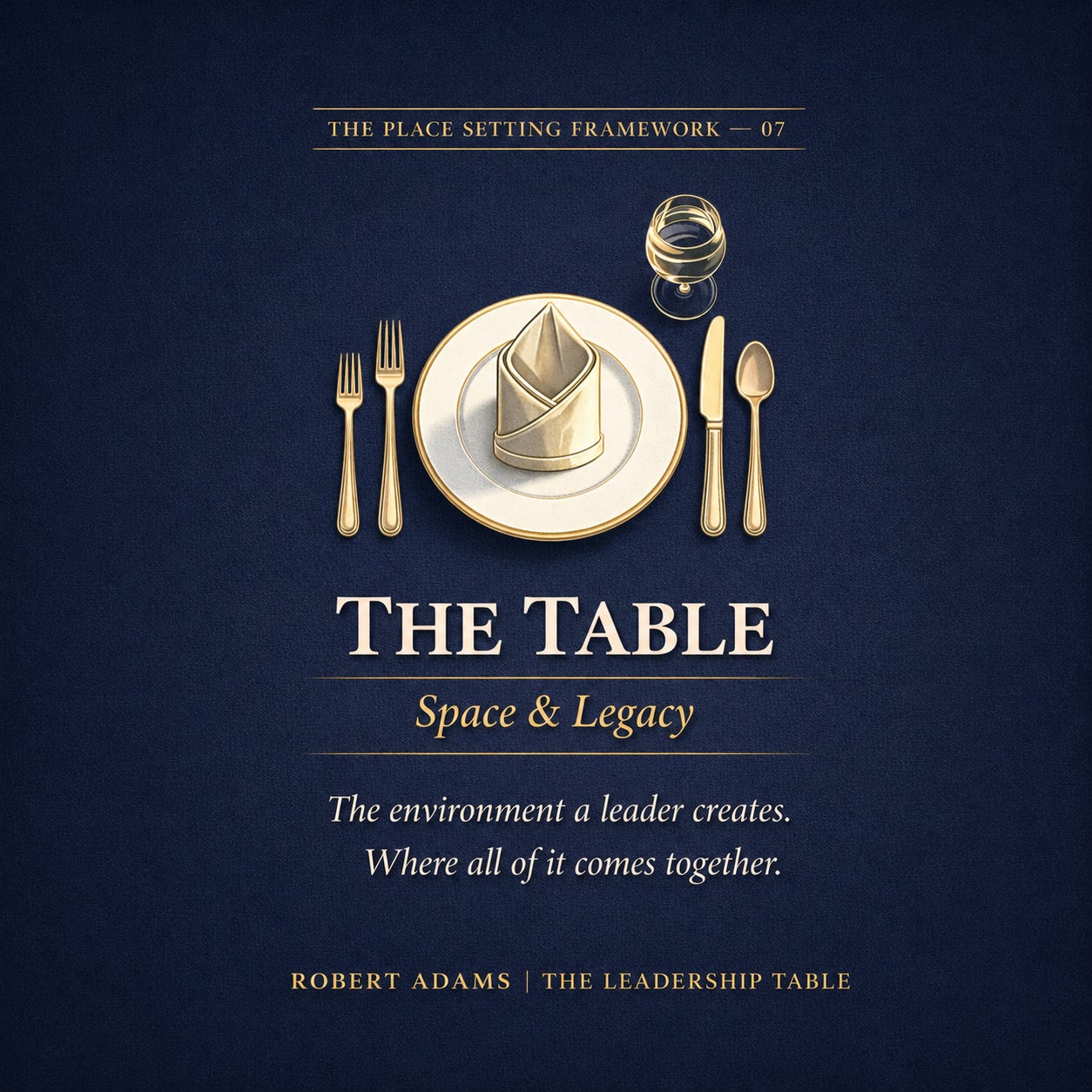
The Table: Space and Legacy
The environment a leader creates. Where all of it comes together.
The table is not furniture. It is the environment a leader creates, intentionally or not. Every leader sets a table. The question is whether it is worth sitting at.
Think about what it means to set a table deliberately. You are declaring who belongs. What matters. What kind of exchange is about to happen. You are establishing standards before a single word is spoken. The people who pull up their chair either feel that or they do not.
The Table is the seventh element and the first condition. Everything else, the Plate, the Knife, the Fork, the Spoon, the Glass, the Napkin, comes together at the table a leader sets. A leader who has built their character but created no space for others to thrive has a plate with nowhere to sit. A leader who has developed precision in conflict but set a table where people are afraid to speak has a knife without purpose.
The table is what determines whether the other six pieces get to do their work. It is the culture before the culture has a name. The tone before the meeting has a slide. The legacy before anyone has left.
My mother never called it leadership. She set a table every day. She made it worth sitting at every time. And every person who sat there left with something they did not have before. That is the standard.
Reflection: When people sit at the table you have set, the one you build every day through your choices and your presence, what do they walk away with?
---
The Complete Place Setting:
The Plate holds the foundation. Everything else sits on this.
The Knife chooses the right edge. Soft or sharp, knowing which the moment requires.
The Fork absorbs with intention. What you take in shapes how you lead.
The Spoon pours into others without keeping score. The selfless dimension.
The Glass stays clear. What leaders fill themselves with, and what they let others see.
The Napkin protects dignity in the small moments. The detail that reveals everything.
The Table is where all of it comes together. The environment a leader creates.
---
My mother set this table every day. She just called it living. I have spent thirty years learning to call it leadership.
This is The Place Setting Framework. I explore one piece of it every week at The Leadership Table on Substack. If this resonated, follow along. The series is just beginning.
Real Leaders. Real Growth. One Table.
Robert Adams
The Leadership Table
Those type of memories are the best when a new meeting starts to take hold.