
Mental Health Is a Leadership Issue.
Stop Treating It Like It Is Not.

Leadership in food service and hospitality has a mental health problem. Not the people in it. The culture around it.
The people are fine. They are among the most resilient, adaptable, and hard-working professionals in any industry. What is not fine is the culture that has historically told them that acknowledging they are struggling is the same thing as failing. That pressing through is always the right move. That the leader who admits they are not okay is somehow less of a leader.
That culture is costing the industry. In turnover. In burnout. In leaders who leave not because they stopped caring but because nobody noticed they were running on empty until they were already gone.
In the Place Setting Framework, The Napkin is the sixth element. Dignity and presence. How a leader treats people in the small moments when nothing seems to require it. The detail that reveals everything.
My mother never made anyone feel small. Not the people she served through catering, not her aging parents on the hardest days, not her children when they failed. She had a way of making people feel that their presence mattered. That they were seen. Not just accommodated. Not just scheduled. Seen. I watched her do this under real pressure, with real exhaustion. It was never a performance. It was simply who she was.
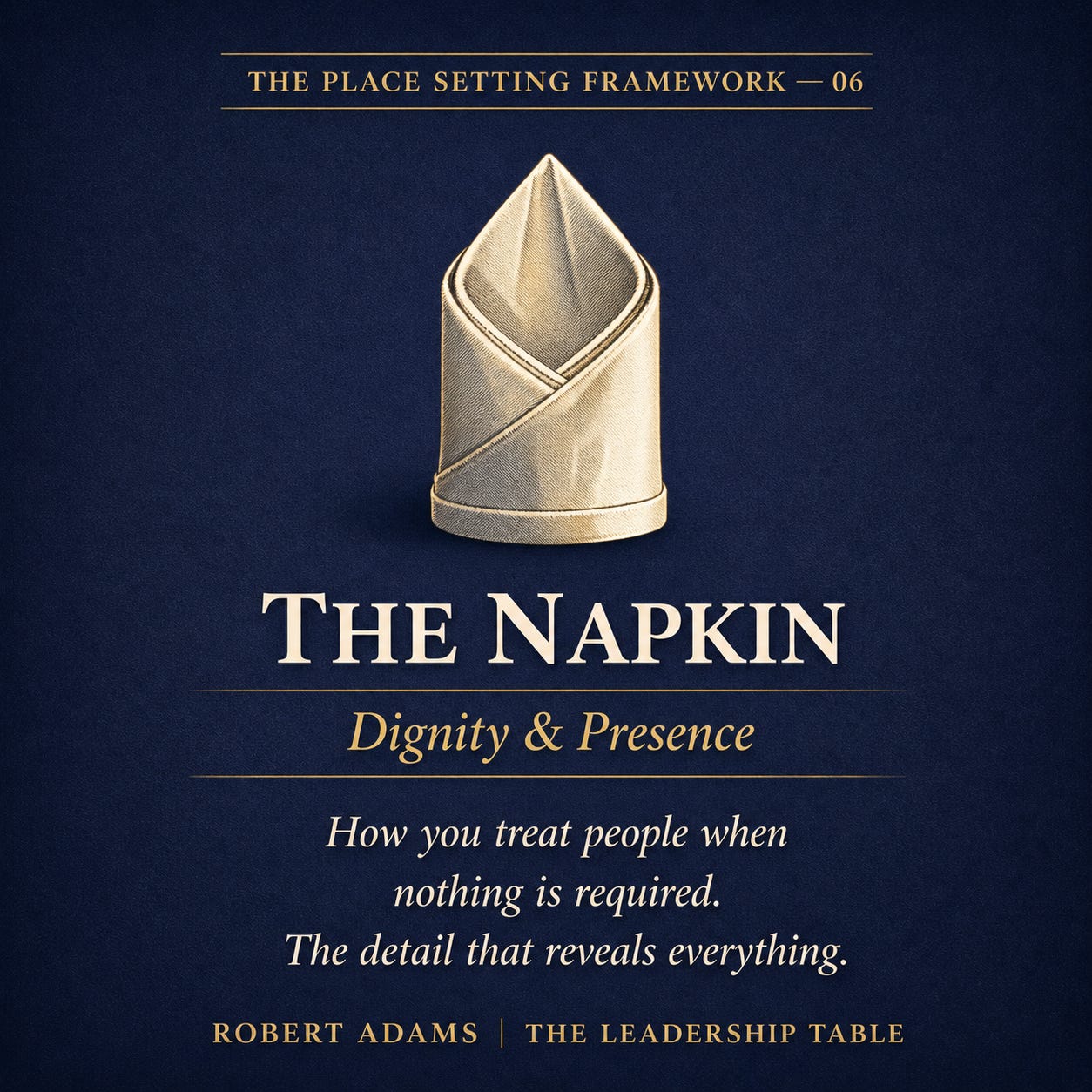
The Napkin is where her leadership showed most clearly. Not in the big decisions. In the small moments no one else was watching.
The Data Nobody Wants to Look At
Deloitte’s research on mental health in the workplace consistently finds that the majority of employees report that their manager has more impact on their mental health than their therapist or their doctor. More impact than a clinical professional. Because of what happens in the ordinary moments at work.
In the restaurant and hospitality industry specifically, the National Restaurant Association has documented the mental health and burnout challenges facing the workforce for years. The data on turnover in hospitality consistently shows that people leave managers, not companies. And the managers they leave are almost always the ones who demanded presence without providing it. Who expected people to show up fully while being fully absent themselves.
Tim Etherington-Judge built Healthy Hospo because he understood something that the industry was not ready to say plainly: that the people pouring care into guests every single shift deserved to have some of that care poured back into them. That a leader who sees only the function and never the human is not leading. They are managing inventory.
What Seeing the Whole Person Looks Like
Seeing the whole person is not a therapy session. It is not an HR process. It is not a mental health awareness initiative that shows up on a poster in the break room and disappears by the following quarter.
It is three things that a leader does consistently.
The first is noticing. Paying attention to what is different. The driver who is quiet in the morning briefing when they are normally engaged. The server who is moving slower than usual and not making eye contact. The team member who has been making small errors they never used to make. Noticing is not diagnosing. It is the first act of seeing someone as a person rather than a role.
The second is asking. Not the performance question. The human question. How are you doing, and I mean it. Not as a greeting. As a genuine inquiry. Most people will deflect the first time. The second time, if the leader has demonstrated that they actually want to know the real answer, people start to share it.
The third is responding without fixing. This is where most well-meaning leaders break down. Someone shares something real and the leader immediately goes into problem-solving mode. They offer solutions. They provide resources. They explain what the person should do. What the person needed was to be heard, not advised. The response that lands is the one that communicates: I see you, I am not alarmed, and you are safe here.
These three things are The Napkin in practice. Noticing, asking, and responding without immediately trying to fix. They take nothing away from performance expectations. They add the human layer that makes those expectations sustainable.
The Culture Question
Here is the harder conversation.
A leader cannot create psychological safety for their team if they do not have it for themselves. A leader who is running on empty, who has never been asked how they are really doing, who has learned through experience that showing vulnerability in their organization leads to being sidelined, cannot consistently extend to their team what they have never received themselves.
This is why mental health as a leadership issue is not just about what leaders do for their teams. It is about the culture that leaders live inside. Whether their own leaders see them as a whole person. Whether there is space in their organization to not be okay without it becoming a liability. Whether the standard of toughness that everyone performs has any room in it for honesty.
The organizations that are winning the talent and retention challenge in food service and hospitality right now are not winning on compensation alone. They are winning because someone in the leadership chain decided that people are not functions. They are humans doing hard work in a difficult industry, and they deserve to be treated accordingly.
That decision starts with one leader. One conversation. One small moment of genuine presence that signals to someone: you matter here as a person, not just as a performer.
That is the Napkin. The small thing that reveals everything.
Episode 65 of A Student of Leadership drops tomorrow at 6:00 AM and goes deeper on what this looks like in practice in food distribution and hospitality operations. Link in the show notes.
Friday’s Breaking Bread has one practice from this week worth taking into your next week. It drops at 12:45 PM.
Real Leaders. Real Growth. One Table.
Robert Adams
The Leadership Table
The observation that "responding without fixing" is the hardest of the three landed for me.
When I think about why this particular one is hardest, a structural issue comes into view. The act of giving advice produces, in the moment, a sense of being useful on the side of the person doing the advising. When you're simply listening, that internal reward is absent, and almost unconsciously, you start tilting the weight of the conversation toward "I want to do something." This isn't a matter of personal goodwill — it's a dynamic rooted in how the brain itself works.
What complicates this further is that unsolicited advice, even when offered in good faith, tends to be read by the receiver as "this person wanted to say something for their own sense of usefulness more than they wanted to listen to me." The same words carry different meanings depending on whether the receiver asked for them. Good intent isn't a defense.
Maybe the key to sustaining your third practice isn't trying to suppress the urge to advise through willpower, but knowing what structural motives are at work on your own side. Once you see them, the moment the urge to advise rises, you can pause and ask: "is this for them, or for my own sense of being useful?" You may not erase the urge completely, but it becomes something you can observe.