
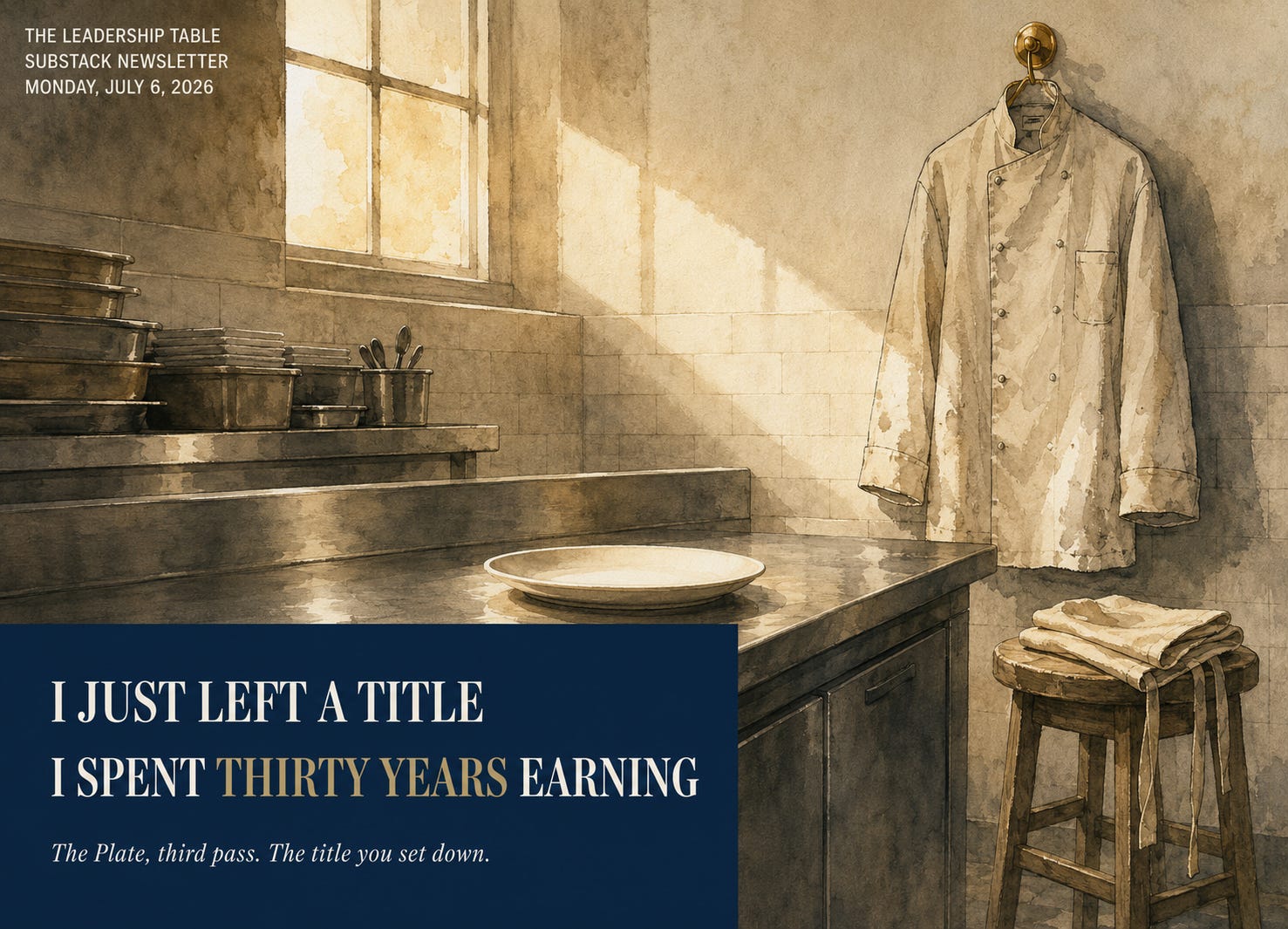
I Just Left a Title
I Spent Thirty Years Earning

Most leaders are far more attached to their titles than they realize.
The role gets folded into the identity. The conversations about who you are start to merge with the conversations about what you do. Eventually the two become indistinguishable, and the leader has stopped asking which one would survive if the other one disappeared.
I just walked away from a title I spent thirty years earning.
Today is the first newsletter I am writing without an EVP role attached to my name. Friday was my last day at UniPro Foodservice, after a decade in that role and three decades in the food distribution industry. This morning I opened my laptop and got to work on something that has been running in the background since long before this transition was on a calendar. A Student of Leadership, LLC, full-time. The Place Setting Framework. The leaders I coach. The book that is being built. The work itself.
What is different is not the work. It is what is no longer behind my name.
This is the piece I wanted to write to you in the first newsletter of Q3. Not because the transition is the story. The transition is just the moment. The leadership lesson is what happens when a leader who has been carrying a title for a long time finally puts it down and watches what is left.
I want to tell you what I saw.
Thirty Years and the Quiet Tradeoff
Most senior leaders do not realize how much of their daily energy is going toward maintaining a position rather than doing the work the position is supposed to make possible. The optics of the role. The relationships the role demands. The visibility that the role requires regardless of whether visibility is what produces the actual outcome. Titles ask leaders to carry weight that is not the work itself.
Some of that weight is necessary. A title creates the platform for decisions that need a platform. A title gives a leader access to rooms where some conversations have to happen. None of that is a critique. The structural function of titles is real.
What I had not been honest with myself about was how much of my own energy had been going into the maintenance and how little had been going into the doing. The thing I had built the title to do, develop leaders, was mostly happening in the cracks of a calendar dominated by everything else. The ratio had crept in a direction I had not noticed.
Thirty years of food distribution leadership taught me a great deal about operations, scale, retention, and the kind of leader people will follow into a hard quarter. It also taught me that the senior level of any organization is where title maintenance starts to crowd out the work the title was meant to enable. Most senior leaders feel this. Few of them name it. Almost none of them act on it.
In the Place Setting Framework, this is the question The Plate asks. What are you actually serving your team. Not what your role description says. Not what your calendar implies. What lands.
The Trap You Cannot See From Inside It
The hardest part of title-based leadership is that the people inside it cannot easily see how much of it has become performance.
Everything is calibrated to the title. The communication style. The presence in meetings. The opinions that get shared and the ones that stay quiet. The leader genuinely believes they are showing up as themselves, and they are, but it is the version of themselves that the title has shaped over years.
Stepping out of a long-held role is the only way to see how much of it had become structural. I am not recommending it as a strategy. I am observing it as a reality. The people I have watched do this well, and the people I have watched do it badly, share one thing in common. They were carrying more identity in the title than they realized.
Three Questions Worth Sitting With
Whether you are six months into a title or thirty years into one, three questions worth asking yourself this week.
What part of your daily energy is going to maintaining the title rather than doing the work the title is supposed to make possible. Be honest. Most senior leaders will discover the ratio is more lopsided than they expected.
What conversations are you avoiding because the title makes them feel more weighted than they need to be. Titles inflate the perceived stakes of conversations that, stripped of position, are simply leadership work. The harder conversations get postponed. The performance gets maintained. The work suffers.
If you walked away from your title tomorrow, what would you do on Monday morning. Not as fantasy. As diagnostic. The leaders whose answer is the same as what they are already doing have aligned the title to the work. The leaders whose answer is significantly different have a gap between role and contribution that is costing them more than they realize.
AI and the Title Question
AI is changing what leadership actually requires. The maintenance work of senior leadership is being automated faster than most leaders are willing to admit. Status updates. Information synthesis. Coordination overhead. As the operational scaffolding of the role gets thinner, the question of what the title was actually supposed to enable becomes harder to avoid.
The leaders who matter in the next decade are the ones whose work actually requires their judgment, presence, and voice. Not the leaders whose title produces the appearance of those things. Title-based authority is depreciating. Earned authority is appreciating. The gap between the two is getting harder to hide every quarter.
What you have been carrying in your title may be larger than you have been willing to look at. Most senior leaders will not look at it until something forces them to. Walking away from one was what forced me. You do not have to walk away to do the work. But you have to be honest about what is yours and what belongs to the role.
The Play This Week
Pick one piece of work you have been doing that the title made you do but the work itself does not require. One meeting. One signoff. One status conversation. One ceremony. Stop doing it for one week. Notice what happens. If the actual outcome of the role is unaffected, the work was title maintenance. If something cracks, the work was load-bearing and now you know that for sure. Either way, you learn something the title would not have let you learn from inside it.
Friday’s Breaking Bread on LinkedIn takes one piece of this and makes it operational before the weekend. It drops at 6:45 AM.
Episode 72 of A Student of Leadership drops tomorrow at 6:00 AM. It is the spoken version of this piece, with more of the personal context and the operational specifics from the last few weeks of the transition. Links in the show notes below.
Q3 has begun. New chapter. Same framework. Same voice. Same work, finally with the room to do it fully.
Real Leaders. Real Growth. One Table.
Robert Adams
The Leadership Table
Robert, congratulations on the new chapter. One idea that stood out to me is your distinction between maintaining a title and doing the work the title was meant to enable. That's a question every leader should revisit periodically. Titles create authority, but they can also create an identity that's difficult to separate from the person behind the role. The true measure of leadership isn't whether influence disappears when the title does, it's whether people continue seeking your perspective because of the value you bring. In the end, positions are temporary, but the impact we have on developing others is what ultimately outlasts any title.